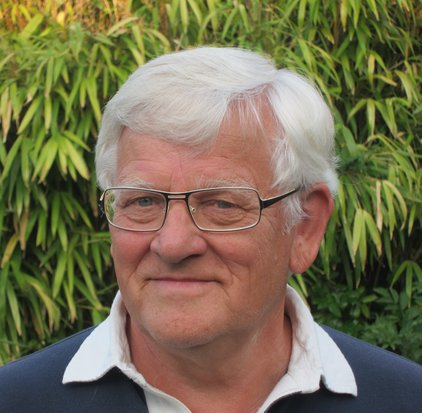
Poul Erik Lindelof
Professor emeritus
Niels Bohr Institute
University of Copenhagen
(UCPH)
http://www.nbi.ku.dk/ansatte/?pure=da/persons/78977
PhD 1969 (physics, DTU & UCPH)
Dr.Scient. 1981 (physics, UCPH)
MA 2013 (prehistoric arhaeology, University of Copenhagen)
e-mail: lindelof0006@gmail.com, IPhone: +45 30280006
Curriculum Vitae
1938: Born in Odense, Fyn
1945-50: Ida Holst Realskole, Svendborg
1950-1957: Roskilde Cathedral School
1961-65 Egmont College
1963: MSc (EF), Technical University of Denmark (DTU)
1965-67: Sergeant in the Danish Air Forces
1969; Licentiatus Technices (PhD), DTU
1969-70: Postdoc at Techn.University, Finland
1971-73: Postdoc at Lancaster University, England
1973: Associate Prof., University of Copenhagen (UCPH)
1974: Changed name from Poul Erik Gregers Hansen to Poul Erik Lindelof
1981: Dr.Scient. at UCPH
1986: Head of Molecular Beam Epitaxy Center, UCPH
1988: Reader (Docent) at Niels Bohr Institute, UCPH
2000: Vicedirector, Nanoscience Center (UCPH)
2001: External Professor at UNSW, Sydney, Australia
2005: Professor at Niels Bohr Institute, UCPH
2007: Royal Society of Arts and Sciences in Gothenburg
2008: Emeritus Professor, Niels Bohr Institute, UCPH
2011: BA in Prehistoric Archaeology, UCPH
2013: MA in Prehistoric Archaeology, UCPH
2014: Consultant in physics-based archaeology, UCPH
2014-18: Co-PI at CONEXT (interfaculty collaborative project of neutron and X-ray research)
2015-20: Research training of pupils at Nørre Gymnasium and Christianshavns Gymnasium
2019: Attached to the National Museum of Denmark
*) Bog udgivet (2021): Min tid i fysik 1958-2008
https://www.amazon.it/Min-tid-fysik-1958-2008-Risø/dp/8743019501?asin=B09D3YR256&revisionId=&format=4&depth=1
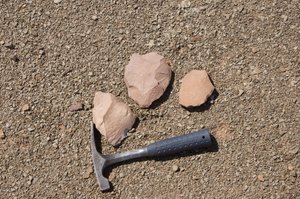
**) Bog udgivet (2017): Palaeolithic Stone Artefacts from Moroccan Sahara
***) CONEXT interview (2017): https://chem.ku.dk/research_sections/finished-projects/conext-temporary/
Dobbeltklik her for at tilføje din egen tekst.
Physics 1958-2008
Archaeology 2008-2023
After my retirement as a professor in physics at the Niels Bohr Institute 2008, I have finished a BA degree (2011) and a MA degree (2013) both in prehistoric archaeology at University of Copenhagen. This has given me lots of knowledge and inspiration to intervene in various archaeological projects. Much study effort the first 4 semester was a coverage of prehistoric archaeology in all parts of Denmark.
To study many localities in Denmark and abroad I used the Google maps to s study in detail the many archaeological places we were taughtt, but it also led me to many potential places for new archaeological sites. Th us I found reminiscence of a ring castle in southern Skåne at Foteviken. Already in 2008 I made a publication on my homepage about my findings (). The finding was supported by Hartmann's Foundation. The interpretation of the exact circle became my BA thesis. A more detailed study of the finding (and the nearby, but removed church) is still to be written as a longer article. In connection with this finding is the discovery by Crumlin-Pedersen of 5 vikingshibs forming a barrier at the intrance to Foteviken. A topic which has also taken my interest.
In the summer 2009 I was lucky enough to have my 1 month "seminargravning" at Gl. Lejre, where Tom Christensen from Roskilde Museum was excavating 3 big viking halls (one being 62 m long). I learned a lot about excavation technique in Gl. Lejre and wrote an informal Photobook about the experiences.
Dating foundation of the Olduvai Culture
For palaeolithic findings the time for the production of artifacts and for the life of the hominids is of paramount importance. Beyond 40.000 years before present (BP) the C-14 method is useless. I review the dating methods for the oldest hominid findings, the Oldowai Culture ~2.6-1.8 million years BPin the enclosed article (Oldowankulturens dateringsgrundlag).
Homo erectus
The evolution of homonids have occurred in steps separated by long periods with no detectable changes. The most extreme case is the stand-still in development between 1.8 and 0,8 mill.yers ago, where Homo erectus w hardly changed and their stone technology also did hardly change. After this long stable situation thing developed faster with species as Homo heidelbergensis, Homo neanderthalis, Homo sapiens and many more. In a short article (Homo erectus), I sketch this development.
Book:
P.E. Lindelof et al.
Palaeolithic stone artefacts from MoroccanSahara
https://www.amazon.com/Palaeolithic-Stone-Artefacts-Moroccan-Sahara/dp/8743005136/ref=sr_1_1?keywords=lindelof+palaeolithic&qid=1577964047&sr=8-1
Palaeolithics at Mata Menge, Flores, Indonesia
Since the discovery of Homo floresiensis in the Liang Bua Cave in 2004, there has been an intensive search for stone artifacts and fossils. Recently Gert van den Bergh et al. (2016) have found the first palaeolithic human fossils on Flores outside the Liang Bua Cave (se "Homo floresiensis" og nogle af dets mange problemer: Arkæologiske, Kronologiske, Evolutionære, Teknologiske og Levevis). In my thesis from 2013 at University of Copenhagen (part1, part 2, part 3, part 4) I have described the excavation, in which I participated in 2011 at Mata Menge and the determined dating of the stone artifacts and the animal fossils found. The life as an archaeological excavator at Mata Menge has been described in the Photobook "Jagten på Homo floresiensis' forfædre" (2011).
https://chem.ku.dk/research_sections/finished-projects/conext-temporary/
Copenhagen University Neutron and X-ray Techniques (CoNeXT)
CoNeXT was a University of Copenhagen interfaculty collaborative project.
Fertilizing the ground and harvesting the full potential of the new neutron and X-ray research infrastructures close to Copenhagen University.
The project was supported for the period 2013-2016 by 27.9 mio DKK by UCPH2016 programme of Excellence. CoNeXT acronym comes from (Co(penhagen University Ne(utron and) X-(ray) T(echniques).
THE PROJECT IS CLOSED
Project period: 2013-2016
Dobbeltklik her for at tilføje din egen tekst.
https://video.ku.dk/search/perform?search=conext
https://video.ku.dk/video/20460887/conext-a-multidisciplinary-project
Power Points
mer
Poul Erik Lindelof
Curriculum Vitae
1938: Born in Odense, Fyn
1945-50: Ida Holst Realskole, Svendborg
1950-1957: Roskilde Cathedral School
1961-65 Egmont College
1963: MSc (EF), Technical University of Denmark (DTU)
1965-67: Sergeant in the Danish Air Forces
1969; Licentiatus Technices (PhD), DTU
1969-70: Postdoc at Techn.University, Finland
1971-73: Postdoc at Lancaster University, England
1973: Associate Prof., University of Copenhagen (UCPH)
1981: Dr.Scient. at UCPH
1986: Head of Molecular Beam Epitaxy Center, UCPH
1988: Reader (Docent) at Niels Bohr Institute, UCPH
2000: Initiator and Vicedirector, Nanoscience Center (UCPH)
2001: External Professor at UNSW, Sydney, Australia
2004: Professor at Niels Bohr Institute, UCPH
2008: Royal Society of Arts and Sciences in Gothenburg
2008: Emeritus Professor, Niels Bohr Institute, UCPH
2011: BA in Prehistoric Archaeology, UCPH
2013: MA in Prehistoric Archaeology, UCPH
2014: Consultant in physics-based archaeology, UCPH
2014: Co-PI at CONEXT (interfaculty collaborative project of the new neutron and X-ray research infrastructures close to Copenhagen University
https://chem.ku.dk/research_sections/finished-projects/conext-temporary/